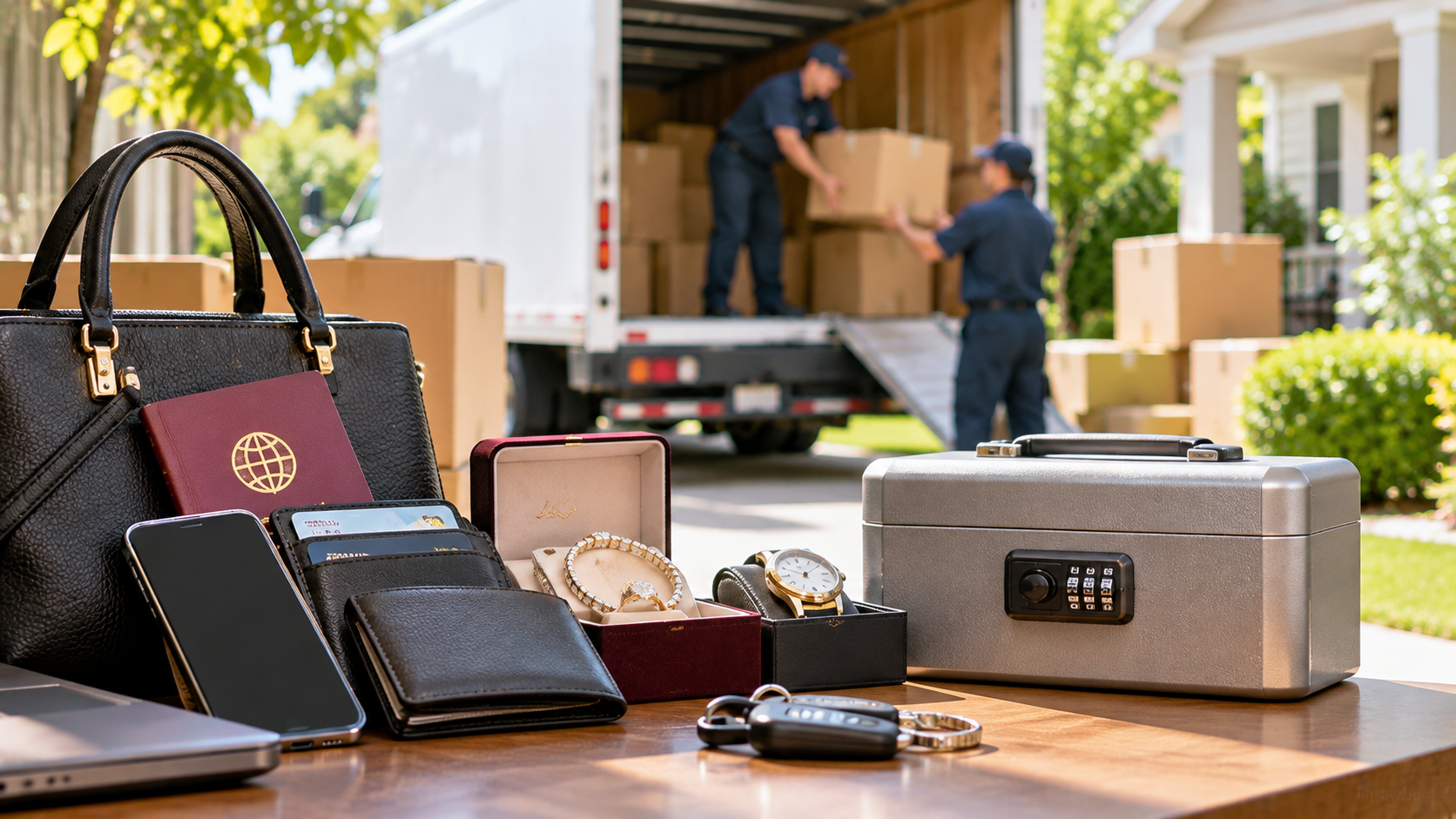
It’s 4 p.m. on moving day. The truck is almost full, the apartment echoes, and you suddenly can’t remember where you put the envelope with your passport and closing papers. Was it in a kitchen box? The one that just went up the ramp?
To keep valuables safe on moving day, carry anything you can’t replace or will need within 24 hours, set up a “do not load” area that everyone knows about, and let only replaceable belongings ride on the truck. This guide shows how to sort your things into those groups, what coverage really pays, and who to tell before the first box moves.
How to Keep Valuables Safe on Moving Day With a Three-Pile System
Sort everything into three piles before the crew arrives: items that stay on you, items that stay locked away, and items that go on the truck. Each pile has a different job, and most moving-day losses happen to things that were never assigned to any pile.
- Carry pile: small, irreplaceable, or urgent items that travel in a bag you hold all day.
- Lock pile: valuable items too large or awkward to carry, such as a guitar, a laptop workstation, or framed art. They stay in a locked room or your own vehicle until you move them yourself.
- Load pile: everything else, packed, labeled, and listed on an inventory.
The rule of thumb is simple. If losing it would make you consider canceling the move, it belongs in the carry or lock pile.
What Should Stay With You on Moving Day?
Keep documents, cash, jewelry, medications, key electronics, and keys with you in one bag. Many movers put these on their own “non-allowable” lists because of liability, so a crew may ask you to take them anyway.

Use a backpack or a crossbody bag that closes completely, and pick one person to hold it. A bag that gets set down “just for a second” is how things go missing.
How to Build a “Do Not Load” Kit
A “do not load” kit is a clearly marked space and container for anything the crew must not touch. It takes about twenty minutes to set up and removes most of the guesswork on a busy day.
1. Pick one lockable spot. A bathroom, a closet, or a bedroom you finish last works well. If the home has no lockable space, use a locked car parked within sight.
2. Label it loudly. Tape a sign on the door and on each container, using plain words like “DO NOT LOAD, PERSONAL ITEMS.
3. Use bright containers. A bright tote or a box wrapped in colored tape is harder to mix up with the load pile.
4. Move items in early. Put your Lock pile items there the night before, so nothing is left on the floor of a room the crew is working in.
5. Photograph it. Take a quick photo of the room and its contents before the first box leaves the house.
6. Keep the key or hold the door. Whoever stays behind keeps the door shut and does not prop it open for the crew.
Picture a couple leaving a two-bedroom apartment. They move a laptop, an external drive, and a small jewelry box into the guest bathroom with a taped sign, put their passports and lease papers in a shoulder bag, and leave the rest to the crew. Nothing about that setup is complicated, but it is easy to follow when the day gets noisy.
If you must use a car for the Lock pile, keep items out of sight and never leave the car loaded overnight.
What Moving Coverage Does and Does Not Pay For
Standard mover liability is often far lower than people assume, which is the best reason not to put valuables on the truck. For interstate moves, the Federal Motor Carrier Safety Administration explains that movers must offer two levels of liability: full value protection and a released value option. Released value costs nothing extra, but it pays no more than 60 cents per pound per article. Under that rule, a 25-pound television that is lost or destroyed would bring back about $15.
The agency’s guidance also flags “articles of extraordinary value,” meaning items worth more than $100 per pound, such as jewelry, silverware, china, furs, and antiques. You are expected to list those in writing before the move. Federal rules also describe the declared level of liability as a statement of what the mover owes, not as insurance.
Moves inside Illinois follow different rules, so do not assume the federal numbers apply to a local job. The Federal Trade Commission suggests asking each mover what it charges to insure goods and what it pays when something is damaged, and checking with your state consumer protection office for in-state rules. It also warns against signing paperwork with blank spaces where prices, dates, or other key details belong.
The Better Business Bureau adds two practical points: confirm whether your mover offers full value protection, and consider extra coverage for high-value items. Separately, call your renter’s or homeowner’s insurer and ask whether belongings in transit are covered. Some policies include them and some do not, and a five-minute call settles it.
Who to Tell on Moving Day (and When)
Tell the crew lead, anyone helping you, and your building contact where the do-not-load area is before the first box moves. Saying it out loud matters more than the sign alone, because people working fast do not always read.
- The crew lead: mention the space and the bag during the first walkthrough, not after boxing has started. Packers wrap what they find, so tell them before they begin. One example of a company that offers moving and packing services along with storage is Lift & Load Moving, a Chicago-area mover. Whichever company you hire, point out the space at the walkthrough and ask the lead to confirm they understood.
- Friends and family helping: a helper trying to be useful may carry the “last box” straight to the truck. Give each person a one-line instruction: “Anything in the bathroom stays.”
- Building manager or doorman: ask where the crew should park, which elevator to use, and whether the loading dock is staffed, so you are not guarding two exits at once.
- Your partner or housemate: decide who holds the carry bag and who stays at the front door. Splitting those jobs keeps one person from being pulled in three directions.
Document Your Valuables Before the Crew Arrives
Photos and a short written list protect you whether or not anything goes wrong. They take less than an hour, and they make any later claim much easier to explain.
Start by photographing high-value items from a few angles, including serial numbers on electronics and any existing scratches on furniture. Save receipts or appraisals for jewelry, art, and instruments in a folder you can open from your phone. If you are declaring any article of extraordinary value, write each item down with a description and an estimated value, and give a copy to the mover in writing.
Then keep a second copy in cloud storage, not only on the device you are about to pack. If the phone ends up in the carry bag and the laptop in the Lock pile, the records survive either way.
Common Mistakes That Put Valuables at Risk
Most valuables are lost through small habits, not dramatic events. Watch for these:
- Leaving the bag on the counter: a bag set down during a busy loading window can disappear into a box.
- Hiding valuables in a “junk” box: a plain box labeled “misc.” can end up on the truck.
- Skipping the final sweep: check the freezer, the attic, drawers that are stuck, the back of closets, and the space under the bed.
- Handing over the only key: keep at least one full set of keys until you have inspected the new home.
- Assuming a helper knows: instructions given once at 8 a.m. are often forgotten by noon, so repeat them when the crew changes or takes a break.
- Sending valuables ahead: if you ship something separately, use tracking and insurance, and keep the receipt.
Frequently Asked Questions
What should I never put on a moving truck?
Never load hazardous items such as gasoline, propane tanks, or lighter fluid, which movers refuse to carry, or irreplaceable items such as passports, cash, jewelry, medications, and laptops. Ask your mover for its non-allowable list early, then sort those items into your carry pile or arrange to dispose of them.
Is it safe to leave valuables in my car during a move?
Only for short trips, and only when items are out of sight and the car is locked. Parked cars are a common theft target. If you must use your car as a locked space on moving day, park it where you can see it and never leave valuables inside overnight.
Does mover liability cover my jewelry?
Usually only if you declare it. On interstate moves, items worth more than $100 per pound count as articles of extraordinary value and should be listed in writing. Otherwise, released value pays only 60 cents per pound per article. For in-state moves, ask the mover for its terms in writing.
How do I keep important documents safe while moving?
Put originals in a zippered pouch or folder inside your carry bag, and keep it with you the whole day. Scan or photograph each document and save the copies in a secure cloud account. Do not mail originals unless you must, and if you do, use tracked shipping.
What should I do if something goes missing?
Tell the crew lead right away, before the truck leaves, and write down what is missing. Ask the mover for its claim process in writing. If the dispute is not resolved, contact your state consumer protection agency for an in-state move, or report it to the U.S. Department of Transportation for an interstate one.
Make Moving Day Boring
The best moving day is the one where nothing interesting happens to your valuables. That comes from a few decisions made ahead of time: one bag, one locked space, one written list, and a clear word to everyone who will touch your things.
Before your move, sit down tonight and place each valuable into its pile. Pack the carry bag, tape the sign on the door, and photograph the contents. That short evening of prep is what lets you stand in the driveway on moving day knowing exactly where everything important is.
